

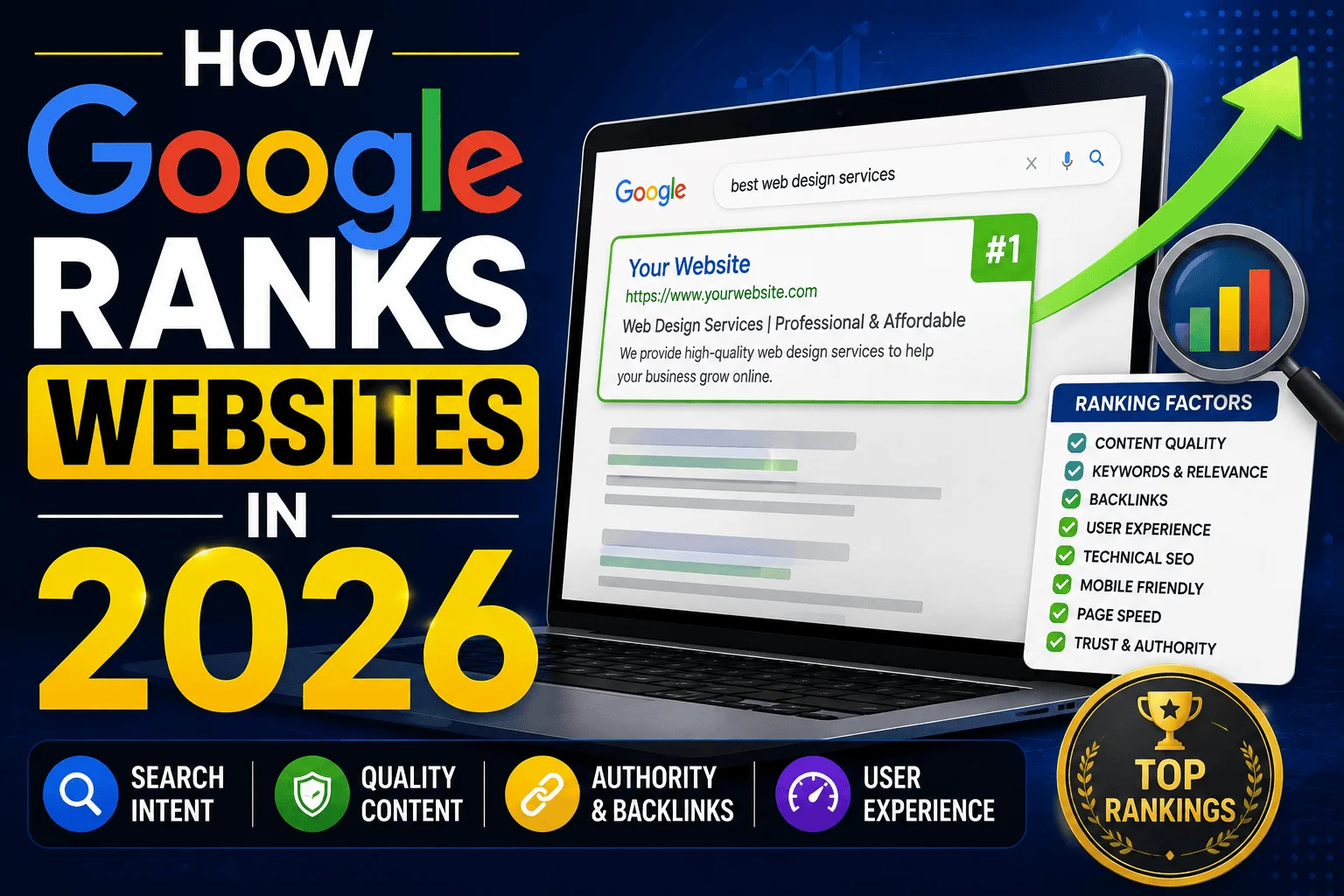
Getting your website on the first page of Google can bring valuable traffic, leads, and customers to your business. But ranking on Google is not simply about adding keywords to a webpage.
Google uses many systems and signals to understand content, evaluate relevance, and determine which pages are most useful for a particular search.
In 2026, businesses need to focus on a combination of high-quality content, search intent, technical SEO, website experience, authority, and user satisfaction.
So, how does Google rank websites in 2026?
Let’s explore the most important areas businesses should understand.

1. Google Understands Search Intent
One of the most important parts of SEO is understanding what users actually want when they search.
Common Search Intent Types
- Informational
- Commercial
- Transactional
- Navigational
Understanding search intent allows you to create content that answers the right questions and provides the right solutions.

2. Helpful Content Is More Important Than Keyword Stuffing
Adding a keyword dozens of times does not automatically make a page rank higher.
Instead, your content should genuinely help the reader.
Good content should:
- Answer the main question
- Provide useful information
- Include practical examples
- Be easy to read
- Demonstrate knowledge
- Solve a real problem
- Offer something valuable
For example, instead of writing a generic article about WordPress, provide practical information about WordPress security, speed, plugins, SEO, maintenance, and common mistakes.

3. Website Quality and User Experience Matter
A website should not only look good. It should also be easy to use.
Visitors should be able to:
- Find information quickly
- Navigate between pages
- Read content comfortably
- Complete forms easily
- Purchase products without confusion
A poor user experience can cause visitors to leave before they become customers.
Important UX Elements
- Clear navigation
- Responsive design
- Fast loading
- Readable content
- Simple layouts
- Clear buttons
- Mobile-friendly pages

4. Website Speed Is Important
Nobody likes waiting for a website to load.
Slow websites can create a poor user experience and reduce engagement.
To improve website performance, businesses can:
- Compress images
- Optimize CSS and JavaScript
- Reduce unnecessary plugins
- Use caching
- Improve hosting
- Optimize databases
- Use a CDN when appropriate
A faster website provides visitors with a smoother experience.

5. Mobile-Friendly Websites Are Essential
People use smartphones to search, shop, read articles, and contact businesses.
Your website should work properly on:
- Smartphones
- Tablets
- Laptops
- Desktop computers
Mobile UX Checklist
- Responsive design
- Easy-to-click buttons
- Readable text
- Simple navigation
- Fast loading
- Mobile-friendly forms
A website that looks excellent on desktop but performs poorly on mobile can lose valuable visitors.

6. High-Quality Backlinks Can Support SEO
Backlinks are links from other websites pointing to your website.
Links can help search engines understand relationships between websites and pages.
However, the goal should not be collecting thousands of random links.
Instead, focus on earning relevant and trustworthy links.
Better Link-Building Strategies
- Publish useful resources
- Create original research
- Write valuable guides
- Build industry relationships
- Earn mentions from relevant websites
- Publish expert content
Quality and relevance are more important than simply having a large number of links.

7. Internal Linking Helps Google Understand Your Website
Internal links connect different pages on your website.
For example, a blog about UX design could link to:
- Web Design Services
- Shopify Development
- WordPress Development
- SEO Services
- Contact Us
Internal linking helps visitors discover more useful content and creates a logical website structure.
Best Internal Linking Practices
- Use relevant anchor text
- Link related articles
- Connect blogs to service pages
- Avoid excessive links
- Create topic clusters

8. Content Relevance Matters
Google needs to understand what your webpage is about.
Use your main topic naturally throughout:
- Page title
- H1 heading
- Introduction
- H2 headings
- Body content
- Image alt text when appropriate
- Internal links
However, avoid forcing keywords into sentences where they don’t naturally belong.
FAQs:
1. How does Google rank websites in 2026?
Google uses many systems and signals to determine which pages are relevant and useful for a particular search. Factors include content quality, relevance, website experience, links, and technical accessibility.
2. What is the most important Google ranking factor?
There is no single factor that guarantees a top ranking. Google evaluates multiple signals depending on the search query and context.
3. Does SEO still work in 2026?
Yes. SEO remains an important way for businesses to improve their visibility in search engines and attract relevant visitors.
4. Does website speed affect SEO?
Website performance contributes to the overall user experience. Businesses should optimize their websites to provide fast and smooth experiences across devices.
5. How long does it take to rank on Google?
There is no guaranteed timeframe. Ranking depends on competition, content quality, website authority, technical SEO, search intent, and many other factors.

